
Posted on March 17, 2026 in Passover Resources, Uncategorized
A Deep Dive Into the Story, Symbolism & Surprising Wisdom
of Judaism’s Most Meaningful Meal
Plus: The Foods You’ll Eat All Week — and Why They Matter
by Rabbi Amy Rader • The Neshamah Institute
“Tell me what you eat, and I will tell you who you are.” — Jean Anthelme Brillat-Savarin
Passover is the most food-saturated holiday in the Jewish calendar — and that is entirely intentional. The seder is designed as a feast of the senses, a meal in which everything you eat is asking you to feel something, remember something, or commit to something. Nothing on the Passover table is accidental.
This is unusual in the world of religious observance, where food is often incidental to the spiritual work. But Jewish tradition insists that the body and the spirit are not separate, that tasting is a form of knowing, and that the most powerful way to make a 3,000-year-old story feel alive is to put it in your mouth.
The great 12th-century philosopher Maimonides wrote that the purpose of the Passover foods is to make the Exodus feel real — not a story about other people in a distant past, but something that happened to your body, that your body remembers. When you taste the bitterness of the maror or dip the parsley in salt water, you are not symbolizing tears. You are, for a brief moment, tasting them.
This article is a complete guide to the meaning behind every food on the seder plate — and the foods you’ll encounter throughout the week of Passover. We’ll go deeper than the surface explanations, into the spiritual wisdom each food carries.
The Seder Plate: A Portrait of the Whole Story
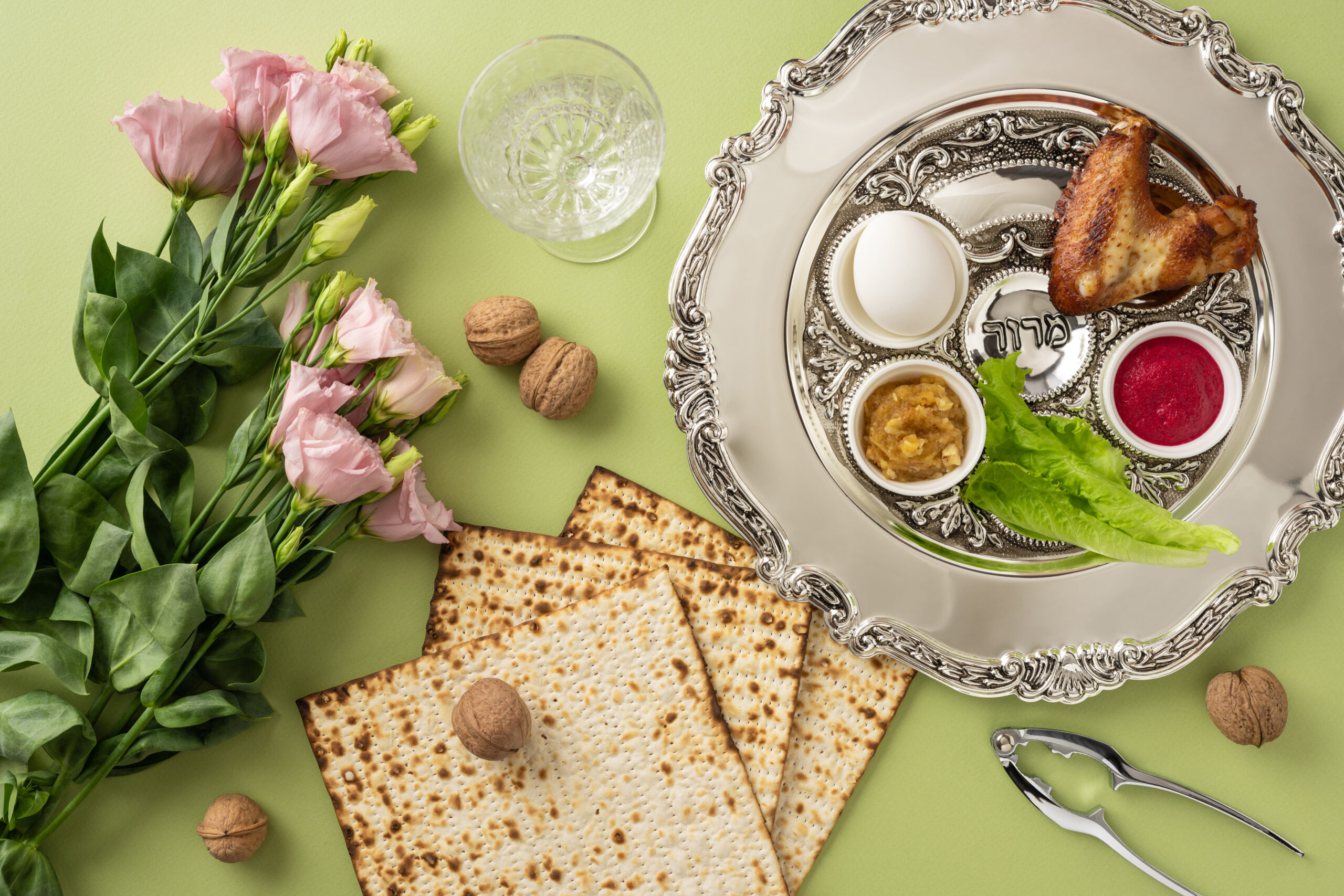
Before we go food by food, it helps to understand what the seder plate as a whole is trying to do. It is a portrait — six or seven foods arranged deliberately, each one representing a different dimension of the Exodus story. Together, they hold the whole arc: slavery, bitterness, labor, sacrifice, hope, spring, new life. No single food tells the whole story. You need all of them.
Matzah — The Bread That Holds a Paradox
Matzah is the central symbol of Passover — so central that the holiday is sometimes called Chag HaMatzot, the Festival of Matzah. And the most remarkable thing about it is this: the Haggadah calls matzah both the bread of affliction and the bread of freedom. The same food, the same meaning, held in two directions at once.
The bread of affliction: this is what the enslaved Israelites ate in Egypt — flat, unrisen, the food of poverty and deprivation. The bread with no time to rise is the bread of people who have nothing and are given no rest.
The bread of freedom: this is what they baked in their haste to leave Egypt. They didn’t wait for the dough to rise because they couldn’t — freedom was moving too fast. Matzah is the bread of people who packed their bags before they were sure they’d be allowed to go.
The spiritual wisdom here is profound: the same experience — eating bread with no yeast — contains both suffering and liberation. The difference is not in the food. It is in the circumstances, the meaning, and the direction you’re moving. Matzah asks: when you look at your own life, do you see the bread of affliction or the bread of freedom? Sometimes the answer is: both, at the same time.
The Chametz Connection
During Passover, observant Jews remove all chametz — leavened bread and grain products — from their homes. The rabbis teach that chametz represents ego and pride: the quality of being puffed up, risen beyond your true size. Removing chametz is not just a dietary practice. It is a spiritual exercise in humility — in asking yourself what has become inflated in your life that needs to be cleared away.
The search for chametz (Bedikat Chametz) on the night before Passover, done by candlelight with children, is one of the most beautiful and underappreciated Jewish rituals. It is a scavenger hunt for the parts of yourself that need releasing.
Maror — The Gift of Tasting Bitterness
Maror is the bitter herb — usually freshly grated horseradish, sometimes romaine lettuce — and its purpose is simple and radical: to make you taste, briefly and physically, what bitterness feels like.
This is not punishment. It is pedagogy. The Haggadah instructs us to eat maror because we cannot truly understand the bitterness of slavery with our minds alone. The body has to be involved. The sting of horseradish in the back of the throat is a teacher.
There is a beautiful midrash that says the maror represents not just the bitterness of slavery but the moment when the Israelites’ lives “became bitter” — when the oppression reached a threshold that made staying intolerable. Maror is not just the taste of suffering. It is the taste of the breaking point, the moment when you finally say: I cannot live like this anymore.
The Spiritual Invitation
Eating maror invites us to ask: what is bitter in my life right now? What have I been tolerating that has become genuinely intolerable? The tradition is not asking us to be masochistic. It is asking us to be honest — to name what is hard before we celebrate what is free.
Many people at the seder cry when they eat the maror. Not always from the horseradish. Sometimes from something else entirely.
Charoset — The Sweetness Within the Hard Work
Charoset is perhaps the most beloved food on the seder plate — a paste or mixture of fruit, nuts, wine, and spices that is sweet, complex, and delicious. And its symbolism is, at first glance, surprising: it represents mortar. The mortar the enslaved Israelites used to build Pharaoh’s cities.
Why is mortar sweet? The rabbis have debated this for centuries. One answer: because even within hard labor, there can be sweetness — the sweetness of community, of shared purpose, of human connection that oppression cannot fully extinguish. Another answer: because the memory of suffering, viewed from the other side of freedom, is transformed. What was once only bitter becomes also sweet.
The Ashkenazi version — apples, walnuts, cinnamon, red wine — is the version most familiar to Jews of Eastern European descent. The Sephardic version — dates, figs, almonds, rose water — reflects the flavors of the Middle East and North Africa. Both are correct. Both are beautiful. And the diversity of charoset recipes across the Jewish world is itself a reminder of the diversity of the Jewish people and their experience.
The Spiritual Invitation
Where in your life have you found sweetness within difficulty? What hard thing has also given you something precious — a strength, a relationship, a depth of character you wouldn’t have otherwise? Charoset asks: can you hold both?
Karpas — The Vegetable That Holds Spring and Tears Together
Karpas is a spring vegetable — usually parsley, sometimes celery, sometimes boiled potato — that is dipped in salt water at the very beginning of the seder. It is often the first ritual act of the evening, and it is deliberately disorienting: we dip a sign of new life and spring into something that tastes like tears.
The salt water represents the tears of the enslaved Israelites. Dipping the green, living vegetable into tears before the story has even been told is the seder’s way of saying: we will hold both of these things tonight. The living and the grieving. The hopeful and the heartbroken. We will not pretend that freedom erases the tears. We will taste them first.
There is also a more hopeful reading: salt water, in the Jewish tradition, is also the water of the sea — the Red Sea that the Israelites crossed to freedom. Karpas, dipped in salt water, might be life on the other side of the sea — still wet from the crossing, still carrying the memory of the water, but alive on the other shore.
Zeroa — The Shank Bone (or Roasted Beet): What We Are Asked to Sacrifice
The zeroa — a roasted lamb shank bone — is the most solemn item on the seder plate, and the one with the most complex history. It represents the Passover sacrifice: the lamb that was slaughtered and eaten on the night of the Exodus, whose blood was smeared on the doorposts to protect the Israelites from the final plague.
The zeroa is not eaten at the seder. It is only looked at — a reminder of a sacrifice that was made, a cost that was paid, a life that was given so that others could go free.
In contemporary Jewish practice, the Temple sacrifice no longer exists. The zeroa is a memorial, a placeholder for a ritual that has been transformed by history into something purely symbolic. And in that transformation, something important has been preserved: the reminder that freedom is not free. That someone, always, pays a price.
The Vegetarian and Vegan Tradition
Many Jewish families substitute a roasted beet for the shank bone — both because of dietary preferences and because the beet’s deep red color evokes the same symbolic resonance. This is a completely valid and beautiful practice, grounded in Talmudic sources. The meaning is in the memory, not the specific food.
Beitzah — The Egg: Resilience, Mourning, and New Life
The roasted egg is one of the most symbolically layered items on the seder plate. It represents the festival sacrifice — a general holiday offering brought to the Temple — but it has accumulated additional meanings over centuries of Jewish thought.
Most famously: the egg is the food that gets harder under pressure. Other foods soften when you cook them. An egg hardens. The egg on the seder plate has long been interpreted as a symbol of the Jewish people — a people who, historically, have grown more resilient, more determined, and more unified under the pressure of persecution.
The egg is also a symbol of mourning: boiled eggs are traditionally served at a shiva (mourning) meal in Jewish custom. Many scholars believe the egg appears at the Passover seder as a reminder of mourning even within celebration — a recognition that our freedom came after and through immense loss. The destruction of the Temple. The lives lost in Egypt. The cost of liberation.
And of course, the egg is a symbol of spring, of fertility, of the new life that is always beginning inside what appears closed and finished. It is the most ambiguous item on the seder plate — holding grief and hope, hardness and new life, simultaneously.
Foods of the Passover Week
Why No Bread? The Meaning of Chametz-Free Living
For the entire week of Passover, many observant Jews eat no chametz — no leavened bread, pasta, cereal, or most grain products. The removal of chametz from the home is one of the most labor-intensive preparations in the Jewish calendar, involving a thorough cleaning of the entire house and the removal or sale of all chametz products.
But why? The symbolism goes deeper than commemoration. Chametz — puffed-up bread — represents ego, inflation, the parts of ourselves that are swollen beyond their true size. The week without chametz is a spiritual practice in simplicity and humility. Eating matzah for a week teaches you, viscerally, what it means to depend on something plain and basic — and to find it enough.
Passover Desserts — Flourless and Surprisingly Beautiful
One of the unexpected joys of Passover cooking is the flourless dessert tradition. Macaroons, flourless chocolate cake, almond torte, meringues, fruit compotes — Passover has generated some of the richest dessert traditions in Jewish cooking, born entirely from the constraint of working without flour.
This is itself a teaching: constraint is generative. When you remove the obvious ingredient, you are forced to discover what else is possible. Many of the most creative things in Jewish culture — including much of Jewish theology and law — have emerged from exactly this dynamic.
The Four Cups of Wine — and What They Hold
The four cups of wine at the seder correspond to the four expressions of redemption in Exodus 6:6–7: “I will bring you out… I will deliver you… I will redeem you… I will take you.” Each cup represents a stage in the journey from slavery to freedom — and the tradition insists that you must drink all four, because the journey is not complete until you have reached the end.
The fifth cup — Elijah’s Cup — is poured but not drunk. It represents a redemption that is still incomplete, a freedom still deferred, a world not yet repaired. It sits at the table as an aspiration, a prayer, and a challenge.
“Taste and see that the Lord is good.” — Psalm 34:9
The Passover table is a theology of taste. Every bite is an argument, every dip a prayer, every sip a moment of gratitude or mourning or hope. Eat it all, slowly, and let it mean something.
Chag Pesach Sameach — may your table be full of good food, deep meaning, and the kind of conversation that lasts long after the dishes are done.
— Rabbi Amy Rader, The Neshamah Institute
About Rabbi Amy Rader & The Neshamah Institute
Rabbi Amy Rader is the founder and Senior Rabbi of The Neshamah Institute, a synagogue without walls serving Boca Raton, Delray Beach, and greater Palm Beach County, Florida. Neshamah offers rich, accessible Jewish learning — including Passover educational programming, hands-on holiday experiences, Torah study, and a warm community for Jewish food lovers, spiritual seekers, and anyone who wants to understand the wisdom hidden inside Jewish tradition. No membership required.
Want to experience the Passover seder in all its depth — in a community that makes it come alive?
Join us at The Neshamah Institute for our Passover programming in South Florida. Whether you’re a first-timer, a returning Jew, or someone who’s been celebrating for decades and wants to go deeper, we have a seat for you at our table. Visit niboca.org to learn about our upcoming Passover events and year-round programming, or reach out directly. Rabbi Amy personally responds to every message.
📍 Serving Boca Raton, Delray Beach & Greater Palm Beach County, Florida
🌐 niboca.org
📧 info@niboca.org
📱 Follow us: @neshamah.institute
© The Neshamah Institute. All rights reserved.
About Rabbi Rader
Rabbi Amy Rader is the Founder and Executive Director of the Neshamah Institute in Boca Raton, a vibrant Jewish community offering meaningful Jewish education for kids, Bar and Bat Mitzvah preparation, High Holiday services, and inspiring Jewish events. Ordained by the Jewish Theological Seminary, Rabbi Rader brings over 25 years of experience helping families connect deeply with Judaism in modern, authentic ways.