
Posted on March 17, 2026 in Passover Resources
How to Hold Grief and Celebration at the Same Table
A Guide for Anyone Facing Passover with an Empty Chair
by Rabbi Amy Rader • The Neshamah Institute
“All who are hungry, come and eat.” – Ha Lachma Anya, the opening words of the Passover Haggadah
There is a particular kind of loneliness that belongs to holidays. The way they arrive every year on schedule, faithful and relentless, regardless of what has changed in the months between. The way the table looks almost exactly as it always did, except for one place where someone is missing.
If you are reading this, you are probably heading into Passover with a loss you are still learning to carry. Maybe it happened recently. Maybe it happened years ago and the holidays keep reopening it. Maybe you are in the formal period of Jewish mourning — shiva, shloshim, or the first year of kaddish — and Passover is arriving in the middle of it, uninvited and unavoidable.
This article is for you.
Not to fix the grief. Not to give you a program for moving through it on schedule. But to offer what the Jewish tradition has always offered people who are mourning: the assurance that grief has a place at the table, that the tradition was built to hold both sorrow and joy at once, and that the empty chair belongs to the seder as much as anything else on it.
The Seder Was Designed to Hold Both
This is the first and most important thing to know: the Passover seder is not a celebration that has accidentally collided with your grief. It is a ritual that was built — from its very structure — to hold sorrow and joy simultaneously. This is not a coincidence. It is theology.
The karpas — a green vegetable, a symbol of spring and new life — is dipped in salt water. The salt water represents tears. Before a single prayer is said, before the story begins, we put new life into tears and taste them together. The tradition is not pretending that spring arrives without grief. It is insisting that we begin honestly — with both.
The maror — the bitter herb — is not optional. It cannot be skipped. We are required to taste bitterness before we eat the meal of freedom. And the Hillel Sandwich — step nine of the seder — combines the bitter herb and the sweet charoset and the matzah together and eats them as one. The tradition does not let bitterness and sweetness exist in separate courses. They are mixed together, on purpose, in the same bite.
Grief and celebration are not opposites in the Jewish framework. They are companions. And the Passover table is one of the most honest places in Jewish life for exactly that reason.
The Name Egypt Holds a Secret
The Hebrew name for Egypt is Mitzrayim — from the root tzar, meaning narrow or constricted. The rabbis have long taught that Mitzrayim is not only a place. It is a condition: the narrow place, the place of constriction, the place where you cannot breathe or move or see the horizon.
Anyone who has grieved knows Mitzrayim intimately. Grief is the narrowest place. The way the world contracts around a loss, the way ordinary things become impossible, the way time moves strangely, the way you find yourself unable to do things you did easily before — this is the experience of Mitzrayim. And the Passover story is the story of moving through it, toward something wider.
The seder does not promise that the crossing will be easy or that the promised land will arrive on schedule. The Israelites spent forty years in the wilderness between Egypt and home. But it does promise that the narrow place is not the end of the story — that there is movement possible, that freedom is the direction, that the wilderness is traversable.
When Passover Falls Inside Active Mourning
Jewish law has a great deal to say about the intersection of holidays and mourning, and the general principle is this: a major holiday — particularly one as joyful as Passover — interrupts the formal mourning period. If you are sitting shiva and Passover arrives, the shiva ends. If you are in shloshim and Passover begins, certain mourning practices are suspended for the duration of the holiday.
This law can feel violent when you are in the middle of grief. The tradition is telling you to stop grieving on a schedule you didn’t choose and celebrate a holiday you don’t feel ready for. It can feel like being told to smile before you’re ready.
But the rabbis understood something important when they established this: public communal joy has a legitimate claim on us even in grief, because grief lived in complete isolation becomes something else — something that can harden into a permanent state rather than a process of moving through. The holiday does not end your grief. It interrupts it, briefly, long enough to let you touch something beyond it. And then it lets you return.
This is not about denial. It is about the tradition’s deep trust that both grief and joy are necessary, that neither can be allowed to permanently exile the other.
What to Do If You Are in Shloshim or the First Year of Mourning
If you are observing formal mourning this Passover, here is some practical and pastoral guidance:
- You are permitted — and encouraged — to participate fully in the seder. The Haggadah’s rituals, the meal, the songs — all of these are appropriate for someone in mourning.
- You do not need to host if that feels like too much. Find a table where you will be held, not a table where you will need to perform.
- You may set a place for the person you’ve lost. This is not required and not universal, but many families find it deeply meaningful. You can light a candle in their memory before the seder begins.
- You are allowed to cry. You are allowed to step away from the table for a few minutes if you need to. You are allowed to tell the people around you that this one is hard.
- The Haggadah has always made room for the person who cannot speak easily — the one who doesn’t know how to ask, the one whose mouth is full of something other than words. You don’t need to be fine tonight.
A Note on the Empty Chair Some families choose to acknowledge an absent loved one at the seder — a brief word, a moment of silence, a candle lit in their name. There is no single prescribed form for this. You might say simply: “We hold [name] in our hearts tonight. Their seat at this table is empty, but their presence at this table is not.” You might read a poem, share a memory, or invite each person at the table to say one word that reminds them of the person who is gone. You might pour a cup of wine for them and leave it full. Whatever form it takes, the acknowledgment matters. Grief that is named is grief that can be held. Grief that goes unspoken at the table tends to fill the room anyway — it is simply more painful when it has no form. |
What the Passover Story Offers the Grieving Person
The Permission to Be Unready
The Israelites left Egypt before they were ready. They left with unleavened bread — dough that had no time to rise, baked flat in their haste. There was no time to prepare properly. The freedom came before they felt capable of receiving it.
Grief often arrives — and often ends — on a schedule that has nothing to do with readiness. You were not ready to lose the person you lost. You may not be ready to sit at the table this year. You may not be ready for the songs, or the food, or the faces of the people who knew the person who is gone.
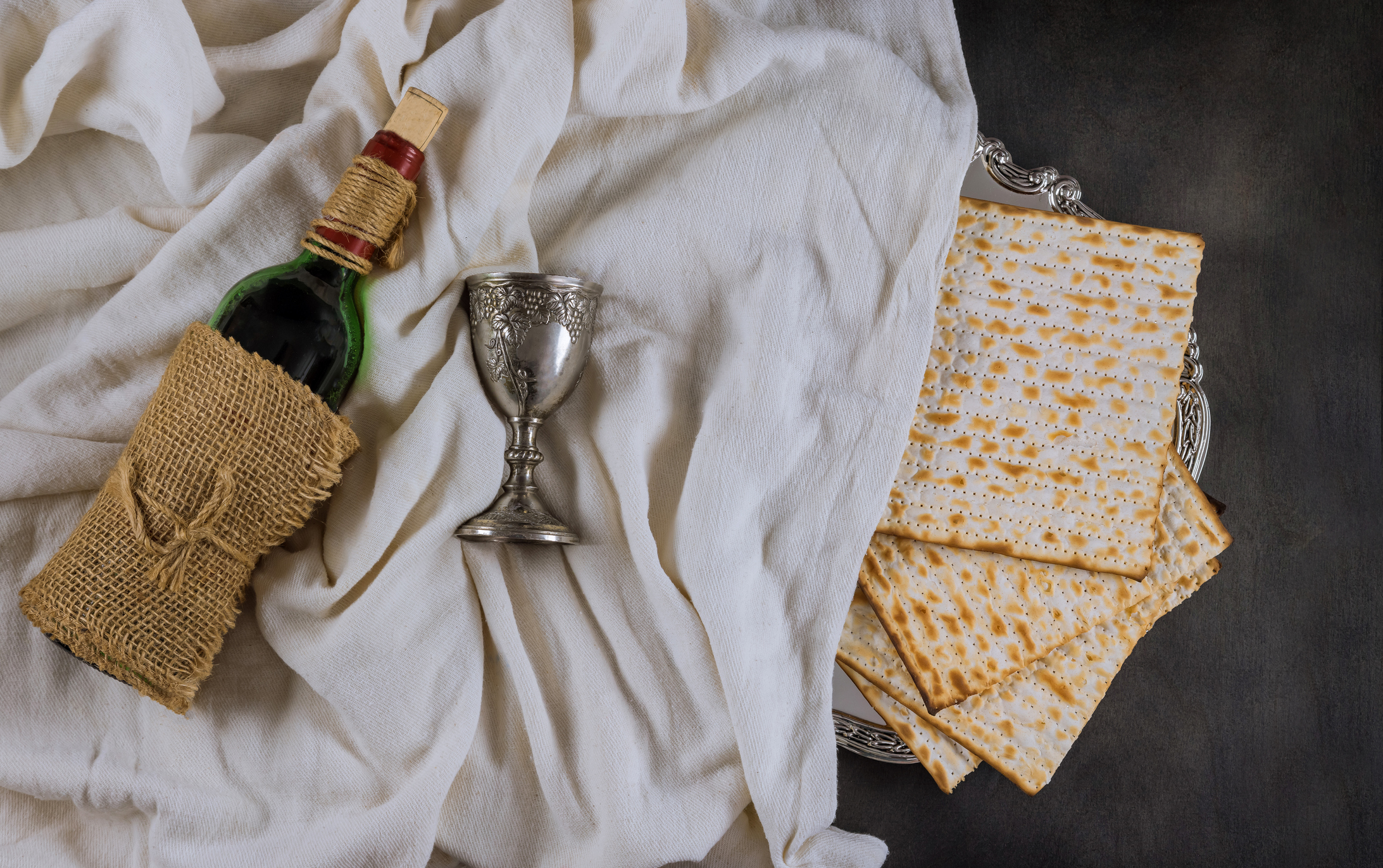
The matzah — the bread baked in haste, without time to rise — gives you permission to be unready. The tradition does not require readiness. It only requires presence. Come to the table as you are. Flat and unleavened and still in the middle of the crossing. That is enough.
The Tradition of Naming What Is Lost
When we recite the ten plagues at the Passover seder, we remove a drop of wine from our cups for each one — diminishing our joy in recognition of the suffering that made our freedom possible. We do not celebrate our liberation without acknowledging the cost.
This practice holds something important for the grieving person: the tradition knows how to diminish joy without eliminating it. It knows that full celebration in the presence of loss would be dishonest. The ten drops of wine are not a performance of sadness — they are an act of honesty, a recognition that freedom and sorrow arrived together, that our cup is full but not without cost.
Your grief is one of those drops. It belongs in the ritual. It does not overflow the cup — it simply makes its presence known in the fullness of the evening.
Elijah’s Cup and the Things We Still Wait For
At every Passover seder, a cup of wine is poured for Elijah the Prophet and left untouched. At a moment in the seder, the door is opened — and for a few seconds, the room is open to the outside world, to the possibility of the prophet’s arrival, to a redemption that has not yet come.
The cup is never drunk. Elijah never arrives. The door is opened, and then quietly closed.
There is no more honest symbol in the entire seder for the experience of grief. The door opened to a person who was supposed to come, and didn’t. The cup poured for someone who isn’t here to drink it. The waiting that is built into the ritual — the acknowledgment that some arrivals have not yet come, that some reunions are still pending, that hope and absence can coexist in the same evening.
When you open the door for Elijah this year, you are not alone in waiting. The entire Jewish people has been opening that door for thousands of years, hoping. Grief and hope are not opposites. They are what you hold in two hands at once.
Dayenu — And What “It Would Have Been Enough” Means When You Have Lost Something
Dayenu is the seder’s most beloved song — a joyful, cumulative declaration that each act of divine kindness would have been sufficient even without everything that followed. “If God had only taken us out of Egypt — Dayenu, it would have been enough.”
When you are grieving, Dayenu invites a different kind of reflection. Not forward — counting blessings yet to come — but backward, counting what was given before the loss. If I had only had that one Passover with them. If I had only heard them sing that one song. If I had only been in the same room with them one more time.
Dayenu, in grief, becomes a practice of gratitude for what was — not resignation to what is lost, but an honest accounting of what you were given. It is one of the most demanding and beautiful spiritual practices available to a mourning person: to say, even now, even with this empty chair — it was enough. It was more than enough. I am grateful for every drop.
How to Take Care of Yourself at the Table
Grief at a holiday gathering can arrive without warning and leave just as suddenly. Here are some things that may help:
- Let one person at the table know how you’re doing — not the whole table, just one person who can check in with you and give you a quiet signal if things get hard.Tell someone before the seder.
- A short walk, a few minutes in a quiet room. The seder will hold without you for five minutes, and you can come back when you’re ready.Give yourself permission to leave if you need to.
- You don’t need to be okay for the sake of others at the table. The people who love you would rather have you honestly than performatively.Don’t perform.
- Music bypasses the thinking mind and goes somewhere else. If Dayenu or Chad Gadya makes you cry, let it. That’s the tradition working.Let the songs do their work.
- The body needs to be fed, even when grief makes food feel irrelevant. The seder meal was designed as an act of nourishment, of care. Accept it.Eat.
- The last thing the seder gives you before it closes is a piece of the matzah that was hidden at the beginning — the bread of affliction and freedom — retrieved by the children and returned to the table. There is something in that arc worth receiving, even tonight.Stay for the Afikomen.
A Passover Teaching for the Mourner: The Splitting of the Sea
The Talmud records that when the Israelites crossed the Red Sea and reached the other side safely, the angels in heaven began to sing. God silenced them.
“My creatures are drowning in the sea,” God said, “and you want to sing songs?”
This teaching is offered every year at Passover as the reason we remove drops of wine for each plague — to remind us that the Egyptians, too, were human, and their suffering diminishes our joy. But it speaks equally to the mourner at the table.
The tradition knows that not everyone at the seder table is singing freely. It knows that some people in the room have their own drowned things — their own losses, their own plagues, their own creatures at the bottom of the sea. And it does not ask those people to pretend otherwise.
You are allowed to sit at the table tonight and not sing everything. You are allowed to hold the cup and feel its weight. You are allowed to taste the salt water and not just symbolically. The tradition makes room for the person whose sea has not yet fully parted.
What it asks of you — gently, firmly — is only this: come to the table. Open the door. Stay for the Afikomen. Let the story take one more year to work on you.
The seder ends, every year, with the same words: L’shanah haba’ah biYrushalayim. Next year in Jerusalem. Not this year. Next year. The tradition is patient with how long things take.
So are we.
“Even in the narrow place, there is a way through. Even in the wilderness, there is a destination. Even at a table with an empty chair, there is a seder.” — Rabbi Amy Rader
May this Passover hold you gently. May the people at your table hold you too. And may the memory of the one who is missing be a blessing — present at the table in every song, every bite, every drop of wine removed in honest acknowledgment of a world that is not yet whole.
Zichronam livracha. May their memory be a blessing.
— Rabbi Amy Rader, The Neshamah Institute
About Rabbi Amy Rader & The Neshamah Institute
Rabbi Amy Rader is the founder and Senior Rabbi of The Neshamah Institute, a synagogue without walls serving Boca Raton, Delray Beach, and greater Palm Beach County, Florida. Rabbi Amy has walked alongside many families through loss, and she writes and teaches from her own experience of grief as well as decades of pastoral care. Neshamah offers bereavement support, grief-sensitive holiday programming, and a warm community for anyone navigating loss — with no membership dues and no barriers to belonging.
Grieving this Passover? You don’t have to hold it alone.
The Neshamah Institute holds space for grief with the same warmth and care it brings to celebration. If you are carrying a loss into this Passover — whether recent or long ago — and you are looking for a community that understands, we would be honored to be part of your table. Visit niboca.org to learn about our community and upcoming programming, or reach out directly. Rabbi Amy personally responds to every message.
📍 Serving Boca Raton, Delray Beach & Greater Palm Beach County, Florida
🌐 niboca.org
📧 info@niboca.org
📱 Follow us: @neshamah.institute
© The Neshamah Institute. All rights reserved.
About Rabbi Rader
Rabbi Amy Rader is the Founder and Executive Director of the Neshamah Institute in Boca Raton, a vibrant Jewish community offering meaningful Jewish education for kids, Bar and Bat Mitzvah preparation, High Holiday services, and inspiring Jewish events. Ordained by the Jewish Theological Seminary, Rabbi Rader brings over 25 years of experience helping families connect deeply with Judaism in modern, authentic ways.