
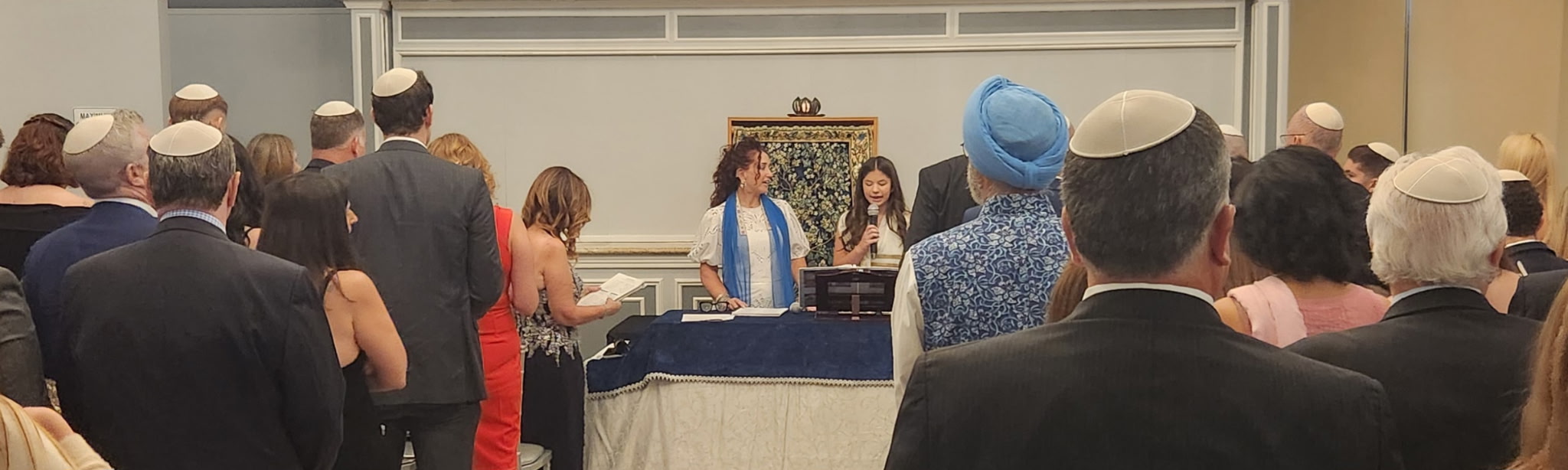
Posted on July 29, 2026 in Neshamah B'nai Mitzvah Stories, Our Stories
Every so often a student’s name turns out to be the whole point of their Torah portion. That is Tova.
Brothers, a Coat, and the Cost of Not Talking
Tova’s Torah portion was Vayeishev, “and Jacob settled.” It opens the story of Joseph, Jacob’s favorite son, singled out with a beautiful coat that his eleven brothers could not help but resent. When Joseph shares dreams of ruling over them, the brothers’ jealousy turns to anger, and they throw him into a pit and sell him into slavery in Egypt. It is one of the most painful family stories in the Torah, a story of jealousy and betrayal that eventually, years later, becomes a story of forgiveness.
Tova asked the question I think every reader of this portion should ask. Why didn’t the brothers just talk to Joseph instead of throwing him in a pit? And why didn’t Joseph stop to consider how his dreams and his coat might land on the brothers who already felt overlooked? Her answer was clear-eyed for a twelve or thirteen year old: everyone in this story let their feelings turn into actions instead of conversation. Nobody stopped to listen.
Tova connected this directly to her own life, to the ordinary arguments she has with her brother. She told our community that it is okay to disagree, and okay to have different opinions, but that the story taught her something she plans to carry forward: talk things through, listen to each other, and look for peaceful solutions before feelings turn into hurt.
Listening as a Spiritual Practice
Tova built much of her service around the Shema, and she offered one of the more thoughtful readings of that prayer I have heard from a student. Sh’ma, she explained, does not simply mean “hear.” It means to listen deeply, with your whole self, to the world, to the people who love you, and to the voice inside that tells you right from wrong. For Tova, becoming a Bat Mitzvah is not only about reading Torah or reciting prayers. It is about learning to actually listen, to her community, to her family, and to her own values.
She carried that same thread into L’dor Vador, from generation to generation. Tova spoke about the family and tradition she stands on the shoulders of, and named one tradition in particular with real warmth: making fried matzah in her Nana’s kitchen every Passover, a breakfast she loves sharing with her family. She promised to pass that tradition, and the values behind it, down to the next generation, just as it was passed to her.
A Good Name, Carried Forward
Tova chose to honor a Holocuast survivor named Tova Friedman, and she was upfront about why: they share a name. In Hebrew, tov means good, and Tova told us plainly that she strives every day to live up to it.
She told Tova Friedman’s story with real seriousness. Born in Poland in 1938, Tova Friedman was five years old when she was forced to hide in the ceiling of her family’s home as children began being deported from her town. She and her mother were later sent to Auschwitz-Birkenau, where she was shaved, tattooed with a number, and held in a children’s camp. She was sent to the gas chamber once, and survived only because it malfunctioned that day. Soviet soldiers liberated her and her mother in 1945. In 1950, the family immigrated to the United States, where Tova Friedman went on to earn a degree in psychology and a master’s in social work, marry, and raise four children. Today, at eighty seven, she continues to share her story, including on TikTok, where our Tova follows her, and she has been invited to speak on International Holocaust Remembrance Day.
What struck Tova most, she told us, was not only that Tova Friedman survived. It was that she refused to let hate win. She chose instead to educate, and to pass her story down so that students like Tova could learn from it.
Mazal tov, Tova. You read a story about brothers who forgot how to listen, and you showed our whole community exactly what it looks like to remember.
I learned so much from you!
With love and blessings,
Rabbi Amy
Ready to Begin This Journey?
Every Bat Mitzvah student who stands on our bimah teaches us something we didn’t expect, a question worth asking, a name worth living up to. That is exactly what our Bat Mitzvah program is built for: personal, meaningful preparation that meets your child exactly where they are.
If you’re wondering what this journey could look like for your own family, I’d love to talk. Reach out to start the conversation, and let’s find out what your child’s Torah portion has been waiting to teach them.
About Rabbi Rader
Rabbi Amy Rader is the Founder and Executive Director of the Neshamah Institute in Boca Raton, a vibrant Jewish community offering meaningful Jewish education for kids, Bar and Bat Mitzvah preparation, High Holiday services, and inspiring Jewish events. Ordained by the Jewish Theological Seminary, Rabbi Rader brings over 25 years of experience helping families connect deeply with Judaism in modern, authentic ways.