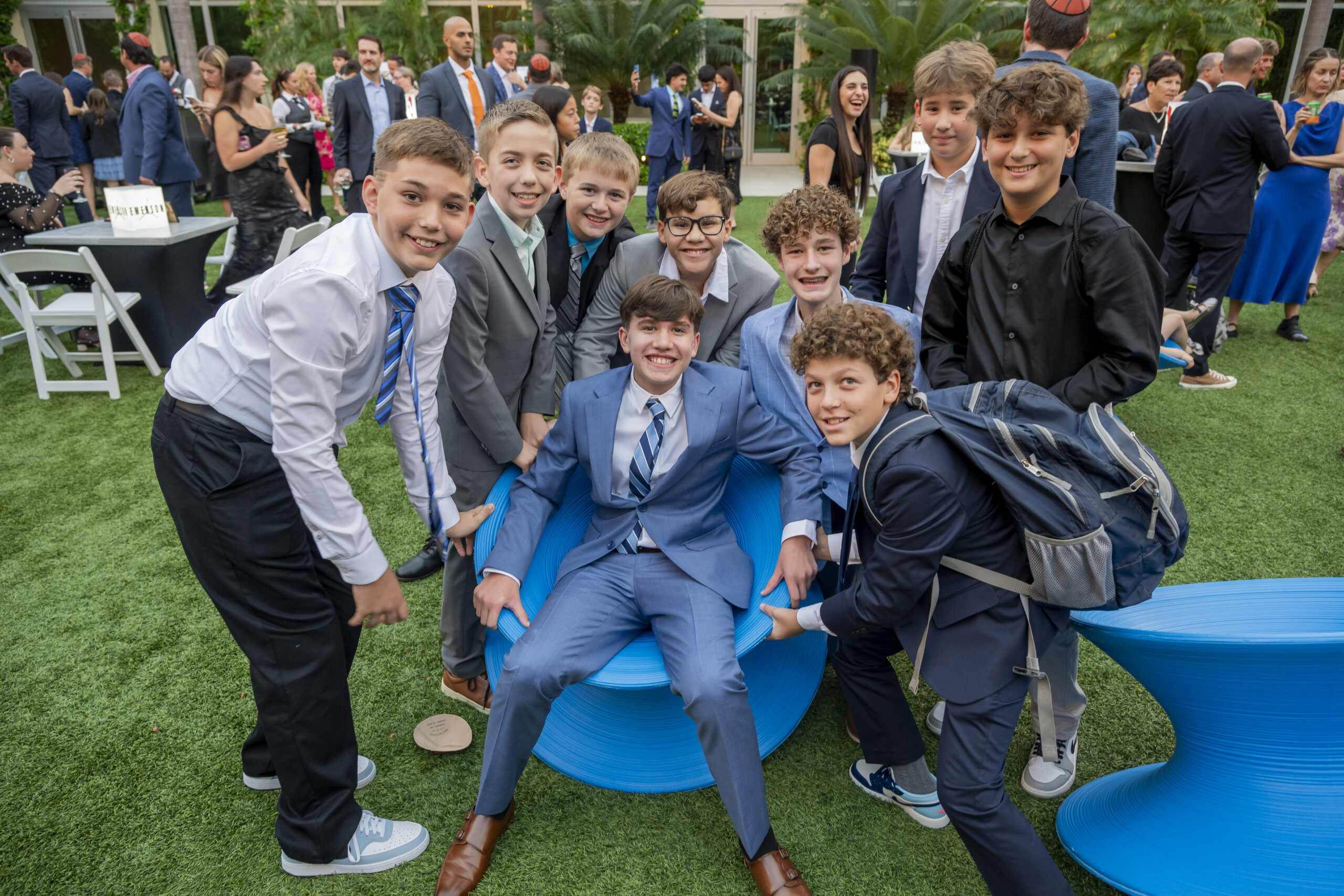
I have known Emerson for years.
I remember him as the little brother, bright-eyed and full of energy, looking up at his older brother Noah the way only a little brother can. There was wonder in those eyes. There was love. And there was that particular kind of joy that comes from having someone to look up to, someone who feels larger than life.
Noah z”l tragically passed away … he was far too young. The loss rippled through his family and through everyone who loved him.
And yet…
When Emerson stood before our community to become a Bar Mitzvah, he wore #11 around his neck. Noah’s number. Carried close to his heart, literally. Not as a monument to grief, but as a declaration: I am still his brother. He is still with me.
When Emerson’s family chose the date for his Bar Mitzvah, they chose it the way families do, looking at the calendar, thinking about what worked.
They were not thinking about Torah portions. And then, as the date came into focus, his parents and I looked at each other and felt the energy just slightly.
The portion assigned to that date was Parashat Noach. It had not been chosen. It had simply been waiting there, as if it had always known.
Parashat Noach is the story of a man who survived the impossible and then had to figure out what to do with the life he was given. It is a portion about holding on. About floating in uncertainty. About the moment the dove returns with an olive branch and you realize the waters are finally beginning to recede.
Emerson understood this in his bones.
In his d’var Torah, Emerson explored the difference between Noah and Abraham, two kinds of righteousness. Noah was good, but he was quiet. He saved himself and his family. Abraham, by contrast, argued. He pushed back. He stood in the gap for others, even for people he had never met, even when the odds were not in his favor.
Emerson asked: is it enough to be a good person quietly? Or does real righteousness mean using your voice for others, even when it is hard?
I think Emerson already knows the answer. I think he has known it for a while, because he has watched what it looks like to love someone fiercely, and he has learned what it means to carry that love forward even when the person is gone.
Even though Noah was deeply felt and deeply missed at this family simcha, this day was all about Emerson. As it should be.
He earned every moment of it. He stood at the Torah with his own voice and he spoke words that were entirely his own. He did not borrow Noah’s story. He brought his own.
The young man who stood before us that day was not the little brother in awe anymore. He was tall, grounded, and deeply connected, to his family, to his Judaism, and to this community. He carried Noah’s number and Noah’s Torah portion and something else too: a clarity of purpose that is rare in someone his age.
He spoke about the rainbow at the end of the flood story, how becoming a Bar Mitzvah is like his own rainbow, a sign of new responsibility, a promise that he has the power to bring more kindness and justice into the world.
I believe him.
Mazel tov, Emerson. You are already doing it.
Rabbi Amy