
Posted on April 28, 2026 in High Holy Day Guides
Rosh Hashanah 2026: Dates, Traditions and Services in South Florida
Rosh Hashanah 2026 begins at sundown on Friday, September 11th. If you are planning to attend services, gather with family, or simply mark the Jewish new year in a meaningful way this year, here is everything you need to know.
When Is Rosh Hashanah 2026?
Erev Rosh Hashanah (the eve of the holiday) begins at sundown on Friday, September 11, 2026.
The first day of Rosh Hashanah is Saturday, September 12, 2026.
The second day of Rosh Hashanah is Sunday, September 13, 2026.
In the Hebrew calendar, this marks the beginning of the year 5787. Jewish holidays begin at sundown because the Torah describes creation as evening and then morning — so each new day, and the new year itself, begins as the sun goes down.
Yom Kippur 2026 follows ten days later, beginning at sundown on Sunday, September 20.
What Is Rosh Hashanah?
Rosh Hashanah is the Jewish new year, one of the holiest days in the Jewish calendar. The name means head of the year in Hebrew. It is the moment when the Jewish calendar turns over and a new year, a new chapter, begins.
But Rosh Hashanah is unlike most new year celebrations. It is not primarily a party. It combines genuine celebration with a serious invitation to reflect. The tradition calls it Yom HaDin — the Day of Judgment — and it asks every person to consider honestly: who have I been this year? Who do I want to become?
That combination of festivity and depth is what gives Rosh Hashanah its particular emotional texture. You can feel it in the music, in the way people greet each other, in the quality of attention that fills a room during services. Something is at stake. And that makes it meaningful in a way that few other days of the year are.
Rosh Hashanah Traditions
The Shofar
The most iconic element of Rosh Hashanah is the shofar, a ram’s horn sounded during morning services. The Torah commands the blowing of the shofar on this day, and the rabbis interpreted its call as an alarm for the soul. Wake up. Pay attention. Something important is here.
There are four distinct calls: tekiah (one long, clear blast), shevarim (three medium, broken blasts), teruah (nine short, staccato blasts), and tekiah gedolah (one very long final blast). The sound is ancient and completely distinctive. For many people who grew up attending High Holy Day services, hearing the shofar each year brings with it a wave of memory and feeling that is hard to explain and impossible to forget.
Apples and Honey
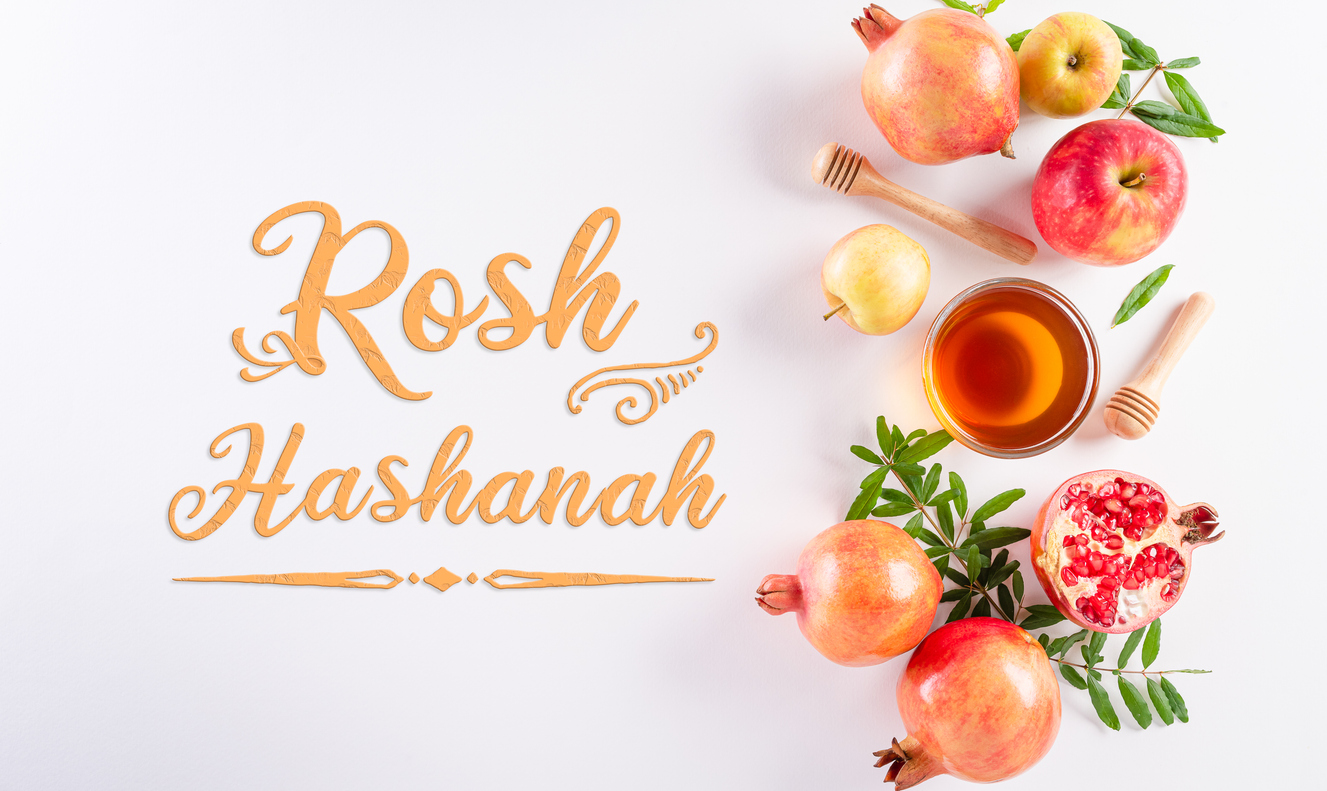
On Rosh Hashanah it is customary to dip apple slices in honey while reciting a blessing for a sweet new year. This simple tradition appears at holiday tables across the Jewish world and is one of the most accessible and beloved entry points into the season, especially for children. Some families also eat pomegranates, whose many seeds represent the hope for a year full of good deeds.
Round Challah
The braided bread that appears on Shabbat tables throughout the year takes a round shape for Rosh Hashanah. The circle symbolizes the cycle of the year, the continuity of life, and the hope that the sweetness of the holiday will come around again and again.
Tashlich
On the afternoon of Rosh Hashanah, many Jewish communities gather near a body of water to observe tashlich — casting bread crumbs into the water as a symbolic release of the previous year’s mistakes and regrets. The word means you will cast away. It is a simple, outdoor, and surprisingly moving ritual.
Festive Meals
Rosh Hashanah is celebrated with festive meals on both evenings of the holiday. In addition to the apples and honey, families often serve foods whose names or shapes carry symbolic meaning — sweet foods, round foods, foods associated with abundance and beginning again.
The Prayers of Rosh Hashanah
Rosh Hashanah morning services are longer and more elaborate than a typical Shabbat service. They follow the machzor, the special High Holy Day prayer book, and include several elements unique to the season.
The Shacharit morning service opens with familiar prayers adapted for the holiday season. The Torah service includes readings from the book of Genesis and the story of the binding of Isaac, and it is during the Torah service that the shofar is first sounded.
The Musaf additional service is the heart of the Rosh Hashanah morning. It includes three central sections: Malkhuyot, prayers affirming divine sovereignty; Zikhronot, prayers of remembrance; and Shofarot, prayers centered on the shofar’s significance across Jewish history. Each section concludes with the sounding of the shofar.
The U’netaneh Tokef prayer appears during Musaf and is one of the most well-known and emotionally powerful pieces of the High Holy Day liturgy. It asks who shall live and who shall die in the coming year — names every possible form of uncertainty and loss — and then answers that teshuva, tefillah, and tzedakah (return, prayer, and acts of justice) have the power to transform the severity of what lies ahead.
Rosh Hashanah Greetings
The traditional Rosh Hashanah greeting is Shanah Tovah, meaning a good year, or the fuller L’Shanah Tovah Tikateivu V’teichateimu, may you be inscribed and sealed for a good year. You might also hear Ketivah v’chatimah tovah, a good inscription and sealing. Between Rosh Hashanah and Yom Kippur, G’mar Chatimah Tovah — a good final sealing — is commonly used.
Rosh Hashanah Services at Neshamah in Boca Raton and Delray Beach
If you are looking for Rosh Hashanah services in South Florida in 2026, the Neshamah Institute offers one of the most distinctive and welcoming experiences in Palm Beach County — and it is genuinely unlike anything you will find at a traditional synagogue.
Neshamah is a dues-free, membership-free Jewish community. We do not require you to join anything, pay an annual fee, or belong to an institution before you are welcome at our table. We believe that access to meaningful High Holy Day services should be open to everyone.
Our Rosh Hashanah morning service is led by Rabbi Amy Rader, whose teaching is warm, educational, and deeply connected to the real questions of contemporary Jewish life. Musical Director Sharon Shear leads the Neshamah Soulmates, whose music is a concert-quality spiritual experience that people travel to South Florida specifically to hear. The Neshamah Children’s Chorus also sings during services, making this a genuine whole-family experience where children are participants, not bystanders.
Services are held at Atlantic Community High School in Delray Beach, a spacious and accessible venue with plenty of parking. All services are also available via livestream for those who prefer to participate from home or who are joining us from outside South Florida.
Because the safety of our community is a responsibility we take seriously, all attendees — adults and children — are required to pre-register before arriving. Professional security is present at every service. We ask that you please do not arrive without a ticket, as entry cannot be guaranteed without prior registration.
Tickets go on sale in April. Pricing is affordable, and financial assistance is available to anyone who needs it. No one is turned away.
We would love to welcome you to Rosh Hashanah 5787. Reserve your seat at niboca.org/high-holy-days/
About Rabbi Rader
Rabbi Amy Rader is the Founder and Executive Director of the Neshamah Institute in Boca Raton, a vibrant Jewish community offering meaningful Jewish education for kids, Bar and Bat Mitzvah preparation, High Holiday services, and inspiring Jewish events. Ordained by the Jewish Theological Seminary, Rabbi Rader brings over 25 years of experience helping families connect deeply with Judaism in modern, authentic ways.