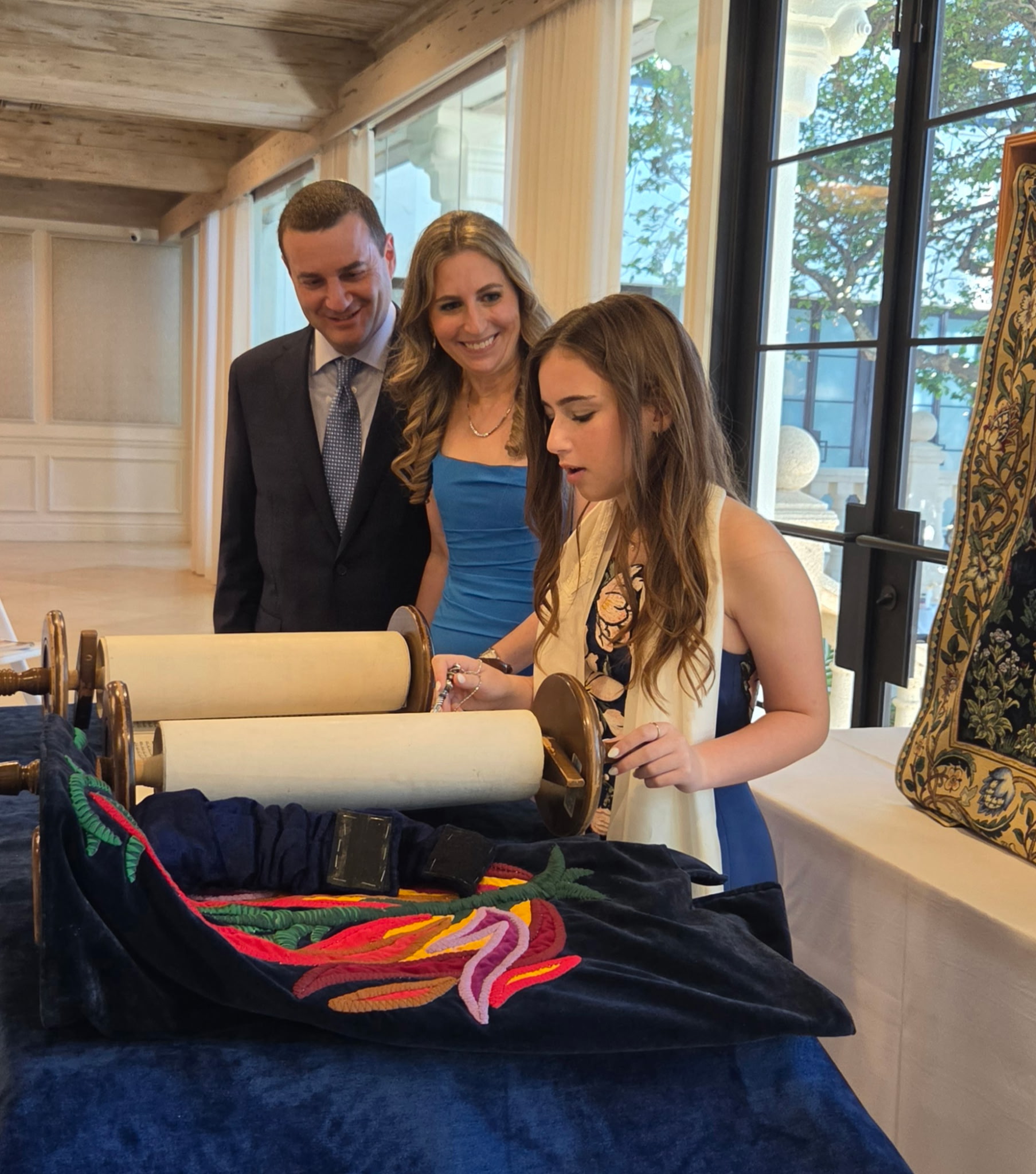
Sasha’s Bat Mitzvah: What a Goat Taught Us About Growing Up
There is a moment in every bat mitzvah that I live for. It is the moment when a young person stops reciting and starts speaking. When the words stop being words and start being truth. That moment arrived for Sasha this April in Boca Raton, and when it did, I don’t think there was a dry eye in the room.
Sasha chanted from Acharei Mot, a portion whose name means “after the death.” It begins in the shadow of tragedy: the death of Aaron’s two sons, Nadav and Avihu. At first glance, that might seem like a heavy place to stand on the bimah for the first time. But Sasha understood something essential about this portion that takes many of us years to learn. The darkness at the beginning is not the point. What comes after is.
Acharei Mot describes the original Yom Kippur service, the ritual the High Priest would perform once a year to bring atonement to all of Israel. At the heart of that service were two goats. One was offered as a sacrifice. The other became something we still talk about thousands of years later: the scapegoat. The High Priest would place his hands on that second goat, confess the sins of the entire community, and send it out into the wilderness. Symbolically, the mistakes of the Jewish people went with it.
Sasha’s question was a good one, and it was her own: what exactly was the point of the goats? Why this ritual? Why this particular act of letting go?
Her answer was honest in a way that adults rarely manage to be in public. She talked about her friend group, a large, close-knit circle where jokes don’t always land right and words slip out before you mean them. She talked about a specific moment, just a few weeks earlier, when she had said something unkind, when she had ignored a friend instead of listening to her feelings. She did not gloss over it or dress it up. She named it clearly.
And then she connected it directly to the Torah.
The whole point of the Yom Kippur service, Sasha explained, is that everyone makes mistakes. The High Priest was not confessing only the sins of wicked people. He was standing in for all of Israel, including the righteous, including himself. The ritual exists because accountability is not a punishment. It is a practice. It is something you have to do again and again, every single year, because being human means you will always have something to answer for.
What Sasha said next is the part I keep thinking about. She said that the right choice does not have to be the easy one. She said that no one can make her apology for her. She said that she cannot rely on others for the heavy lifting.
That is not a thirteen-year-old reciting what she was told. That is a thirteen-year-old who has actually thought about what it means to grow up.
Holiness, Sasha reminded us, is not something that lives only in the synagogue. It lives in how we treat the people around us every day. It lives in whether we listen, whether we own our mistakes, whether we do the hard thing when the easy thing is right there.
Watching Sasha on the bimah, I thought about how rare it is to be that honest in front of your family, your friends, and your whole community. It takes courage. It takes exactly the kind of moral seriousness that Acharei Mot is asking of us.
Mazal tov, Sasha. You did not just become a bat mitzvah this month. You showed us what it looks like to be a daughter of the commandments.
Is Your Child Ready for the Bat or Bar Mitzvah Journey?
At The Neshamah Institute, bar and. bat mitzvah is not a finish line. It is a beginning. We work closely with each student and family to make sure that when your child stands on the bimah, she is not just prepared to chant Torah. She is prepared to mean it.
Our bar and bat mitzvah program is personal, flexible, and rooted in the belief that every Jewish child deserves a celebration that reflects who she actually is. No membership required. No dues. Just a serious, joyful commitment to helping your daughter step into Jewish adulthood with confidence and purpose.
If you are exploring bat or bar mitzvah options in Boca Raton, Delray Beach, or greater Palm Beach County, I would love to talk with you.
Learn About Our Bar and Bat Mitzvah Program
Contact Rabbi Amy Rader